Nine litters used in our own trays, judged on what matters in a cattery: clumping, dust, scent and real cost. No partnership, no commercial tie — we buy everything we test.
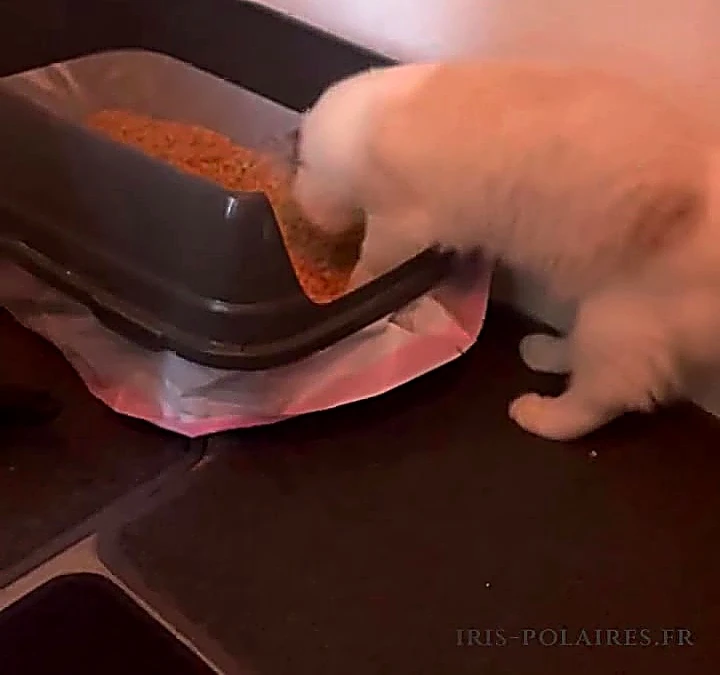
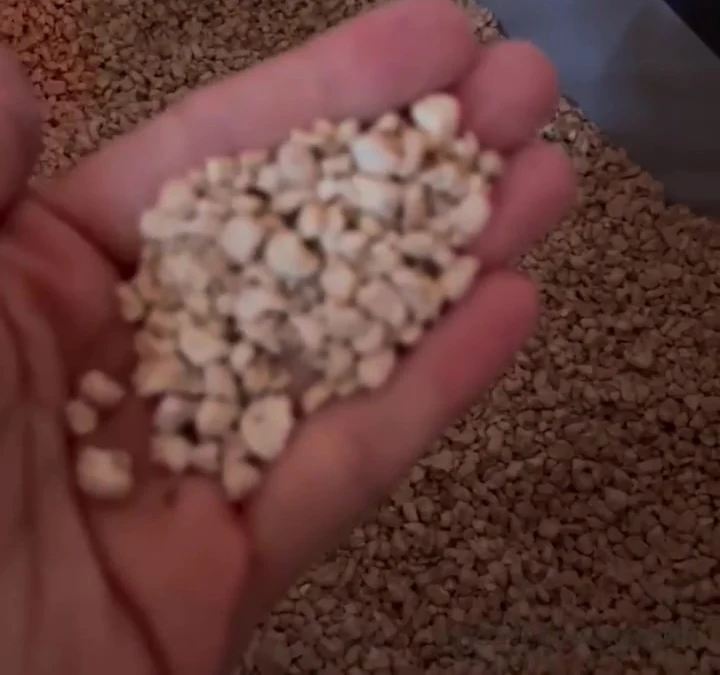
Brontë inspects the corn granules. At our home, no litter enters a tray without first being sniffed, scratched and judged by the interested parties.
Every litter on this page was bought and used at our home, not read off a product sheet. The figures come from the manufacturers; the judgements on clumping, dust and smell come from the tray. The reviews are ranked from the one we keep to the one we set aside, and the detail opens on a click.
A word on the setting. A cattery is not one cat: the usual rule is one tray per cat, plus one, and every tray is emptied and disinfected far more often than in a family home. What is at stake here is therefore not household comfort, but a consumable bought by volume, breathed every day by kittens, and which must stay neutral enough that nobody shuns their tray.
Three bearings for reading this page.
The price per litre lies. A bentonite weighs 800 to 900 g per litre, a corn litter about 420 g: at equal volume, you are not buying the same amount of matter. And what really drives the spend is absorbency — a litter that absorbs 320 % of its weight soils more slowly than one at 200 %, so you remove and top up less. The only honest indicator is the cost per tray per month. Only one brand on this page publishes a duration of use: Tranquille announces 2 to 3 weeks per 4.5 L carton of Fleur de Litière for a 4 kg cat — i.e. about €10 to €15 per cat per month — and about 3 weeks per 6.5 kg bag of Carbonite. The other seven litters say nothing. We therefore give the price per litre and per kilo so the comparison stays readable, knowing that neither is enough on its own.
Scent is a flaw, not a quality. The cat has about 200 million olfactory receptors, against 5 million for us: what we perceive as “fresh” reaches it with an intensity beyond comparison. On the two scented litters of this page, we noticed something more concrete still: an irritation of the airways at the moment of filling the tray, clear on one, very marked on the other. If the fragrance stings the nose of the person pouring the bag while standing, imagine what it represents for a kitten with its muzzle in it.
Dust does not show on the packaging. Two litters on this page are far finer than their pack photo suggests, and grain fineness does everything: it improves clumping and worsens dust, in the same movement. It is also what makes the question of age important: a very young kitten tastes everything, and a swallowed clump of sodium clay is not a trivial incident. A scope precision is therefore needed from the outset: everything we write here holds for adult cats and for kittens over three months, weaned and ready to leave. Our first litters are expected in 2027; we have not yet settled a protocol for newborns and will not pretend otherwise. We detail this point, and what the sources really say about the supposed toxicity of clumping litters, further down this page.
#1
Tranquille
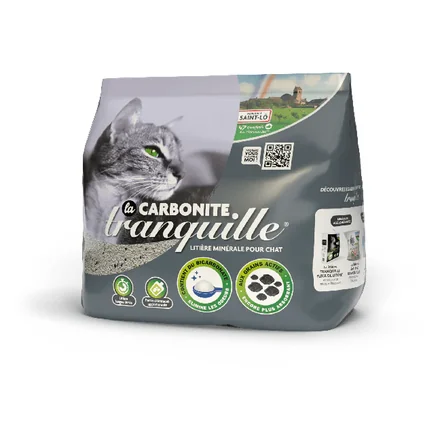
La Carbonite — clumping mineral
Clumping mineral — clay + bicarbonate + active grains
€6.29 for 7.1 L found in supermarkets, i.e. €0.89/L — €10.90 the 6.5 kg bag in direct sale
* Prices recorded in September 2026. The brand sells the bag at €10.90 direct on its own site but states it in kilos (6.5 kg), where supermarkets state it in litres (6.5 to 7.1 L depending on the chain): at bentonite density the two overlap. We keep the in-store price per litre, the closest to what you actually pay. Caution: the brand carries several Carbonite versions — this one “with active grains”, one with activated charcoal, one for neutered cats. The bag we describe reads “contains bicarbonate” and “with active grains”.
The composition
98 % clay grains (bentonite), 1 % sodium bicarbonate, 1 % activated charcoal, adjuvant compliant with regulations. Made in Saint-Lô, Normandy. Published particle-size distribution — one of only two on this page: 3 % below 0.5 mm, 87 % between 0.5 and 2.36 mm, 5 % above. Announced absorbency above 280 %. Announced duration: about 3 weeks per 6.5 kg bag for one cat. The manufacturer’s sheet carries the “compatible with automatic litter boxes” mention. Sold in Auchan, Carrefour, E.Leclerc, Intermarché and Magasins U (French supermarkets), and on the brand’s site.
❄ Our view
This is our new reference, and it takes the Fleur de Litière’s place for a simple reason: it does the same job for markedly less money. We put it in expecting a downgraded product — it is the range below, from the same brand, at half the price per litre. That is not what we found.
The clumps are very good: firm, decisive, lifted out in one piece with the scoop and leaving no residue at the bottom of the tray. That is the criterion that decides everything else, because it determines whether you remove exactly the soiled matter or carry clean litter out with it — and therefore how long a tray lasts before it has to be emptied.
What surprised us most is the odour control, the best on this page. The mechanism is the same as the Fleur de Litière’s and it is nothing like a fragrance: bicarbonate slows the bacterial degradation of urea that produces ammonia, instead of covering it. The Carbonite adds dark grains — the brand’s technical sheet describes them as 1 % activated charcoal — which fix volatile compounds. On heavily used trays, the gap with the bare bentonites on this page is clear.
On paper it sits slightly behind its big sister: above 280 % absorbency against above 320 %, and 3 % of grains under 0.5 mm against 2 %. In use we did not find that gap — neither on how the blocks hold, nor on dust, which stays discreet when pouring. The manufacturer still recommends pouring in a ventilated spot, and that is advice we follow for every clay.
One reservation about the reading rather than the use: the published particle-size distribution only adds up to 95 %. Three per cent, eighty-seven, five: five points are missing. We would rather flag it than pretend not to have seen it — on a page that faults other brands for publishing nothing, the least we can do is read what is published.
What remains is what it shares with every bentonite: it does not compost, it never goes down the toilet, and it leaves the tray clinging to paws. And as with any clumping clay, our reservation stands for very young kittens — we explain that below.
Strengths
Very firm clumps, lifted out in one piece
The best odour control on this page
No scent: bicarbonate and active grains neutralise instead of masking
About half the price per litre of the Fleur de Litière, for a comparable result
Published particle-size distribution: one of only two on this page
Composition published in percentages, made in France (Saint-Lô)
Compatible with automatic litter boxes per the maker, and verified in our trays
Reservations
Announced absorbency > 280 %, behind the Fleur de Litière’s > 320 %
3 % of grains under 0.5 mm, against 2 % for the Fleur de Litière
A published particle-size distribution that only adds up to 95 %
Several Carbonite versions on the shelf: check the bag you pick up
Fine grain: travels out of the tray on the paws
Bentonite: not compostable, never down the toilet
Format stated in kilos by the brand, in litres by the retailers
#2
Tranquille
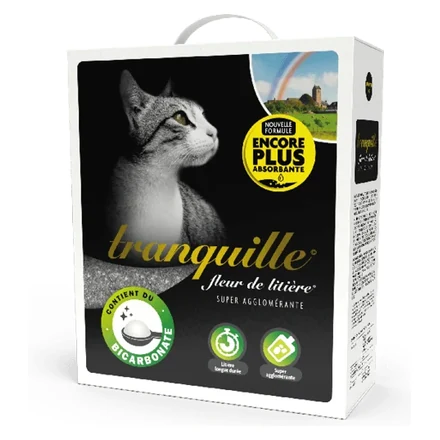
Fleur de Litière — super-clumping
Clumping mineral — fine clay + bicarbonate
€7.30 the 4.5 L box on the brand’s site, i.e. €1.62/L — cheaper in supermarkets
* New formula: 99 % clay, 1 % bicarbonate, announced absorbency > 320 %. Beware, some old retailer sheets still describe a Fleur de Litière “subtly scented” with talc, at 280 % absorption. Check the box in your hand.
The composition
99 % clay grains (bentonite), 1 % sodium bicarbonate, adjuvant compliant with regulations. Clay of Turkish origin, French packaging (SAS Terdis, La Meauffe, Normandy). Recommended depth: 6 cm minimum. Published particle-size distribution — one of only two on this page, with the Carbonite: 2 % below 0.5 mm, 95 % between 0.5 and 2.36 mm, 3 % above. Announced duration: 2 to 3 weeks per 4.5 L carton for a 4 kg cat. Sold in Auchan, Carrefour, Cora, E.Leclerc, Géant, Intermarché and Magasins U (French supermarkets), and on the brand’s site.
❄ Our view
Technically it is the best-made litter on this page: we have nothing to hold against it, except the price. We tested it expecting a compromise somewhere: there is none. Clumping is decisive, the blocks come out in one piece without crumbling, dust stays discreet despite the fineness of the grain, and odour control holds over time.
That last point has an explanation: it is not scented, it is well made. A tray’s characteristic smell comes from the ammonia released by the bacterial degradation of urea, and the 1 % bicarbonate slows that reaction instead of covering it. It is the exact opposite of an added fragrance, and the only form of odour control we accept in a cattery.
The fine grain works in its favour here: the greater the contact surface with urine, the faster the clump forms and the better it holds. Concretely, you remove exactly the soiled matter and nothing else — which is what makes a tray last, and partly offsets the price gap.
It is also, together with the Carbonite, the only brand on this page to publish its particle-size distribution, and the detail is worth reading: only 2 % of grains pass under 0.5 mm. In other words, it is a fine grain, not a powder — and that is exactly what separates it from the Éco+. The manufacturer still recommends pouring in a ventilated spot, which is honest: no clumping clay is entirely free of residue.
There remains the real flaw, and it is serious: at €7.30 the 4.5 L box in direct sale, i.e. €1.62 per litre, it costs nearly five times the Éco+. Over five or six regularly renewed trays, that is no longer a detail — even if it is the only one whose real monthly cost can be estimated, around €10 to €15 per cat. It can be found cheaper in supermarkets than in direct sale. And it is that price, that price alone, which now puts it behind the Carbonite from the same brand: at about €0.89/L, the Carbonite keeps the same promises on clumping and does better on odours, for roughly half the price per litre. The Fleur de Litière keeps the edge on two figures — a higher announced absorbency (> 320 % against > 280 %) and a slightly less fine grain — but we did not find that gap in the trays. The brand still carries other ranges we have not tried, including a Carbonite formulated for neutered cats.
Strengths
Faultless clumping: clean blocks that do not crumble
Little dust despite a very fine grain
No added scent in the current formula
Bicarbonate: chemical neutralisation, not masking
Announced absorbency > 320 %, the highest on the page
Published particle sizes: just 2 % under 0.5 mm, the least fine of the page’s clays
Fully published composition, packaged in France
Reservations
€1.62/L in direct sale: nearly five times the price of the Éco+
About twice the price per litre of the Carbonite, for a very close result
Small formats (4.5 L): a lot of handling across several trays
Fine grain: travels out of the tray on the paws
Bentonite: not compostable, never down the toilet
Old scented formula still described by some retailers
#3
Beasty
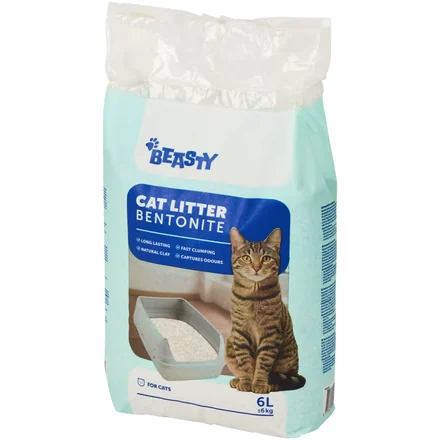
Cat Litter Bentonite — clumping
Clumping mineral — bare clay, Action store brand
€2.99 the 6 L bag (± 6 kg), i.e. €0.50/L — about €0.50/kg
* No scent on the bag we bought — but beware, Action’s online sheet is inconsistent: it describes a lavender-scented litter and its title even points to another product. Check the bag in your hand. Price recorded in August 2026 on action.com; neither absorbency, nor particle sizes, nor a detailed composition is published.
The composition
Bentonite clay. The bag claims “natural clay”, “fast clumping”, “captures odours” and “long lasting”. Nothing further: not one percentage, no particle sizes, no absorption rate, no declared adjuvant. 6 L for about 6 kg, a classic bentonite density. Sold in Action shops only.
❄ Our view
It is not a remarkable litter, and we will not pretend otherwise: it shines nowhere. But it fails nowhere either, and that is precisely what puts it here.
It clumps decently — the blocks form and lift out without crumbling under the scoop. It is not the Tranquille’s hold; it is perfectly usable day to day. Above all, it makes little dust, and that is where it takes the advantage over the Éco+: on the criterion we place at the head of our grid, the Beasty passes where the Éco+ plainly fails. No scent either, no coloured granule: clay, and that is all.
Its real weak point is odour control: fairly mediocre. The tray does not turn to ammonia overnight, but it holds up neither against the Tranquille and its bicarbonate, nor against the corn litter, which lets nothing escape. Across several trays, in a cattery, that shows.
Second reproach, more prosaic: it goes everywhere. The grains leave the tray, spread around it, cling to the paws and travel through the room.
So why third place for a litter we find unremarkable? Because our grid holds in three refusals — no dust, no scent, no colours — and it is the only one, along with the two Tranquille litters, to pass all three without a major reservation. At €0.50 per litre, it is the best neutrality-to-price compromise on this page. That does not make it better than the Tranquille litters: simply far cheaper, and without a serious fault.
Strengths
€0.50/L: among the cheapest on the page
Little dust, where the Éco+ falls down
No scent, no colouring, no blue granules
Decent clumping, blocks that lift out cleanly
6 L for ± 6 kg: real matter per litre
Available in every Action shop, no ordering
Reservations
Fairly mediocre odour control: its real flaw
The grains leave the tray and spread everywhere
No published technical data: neither absorption nor particle sizes
Inconsistent online sheet: a lavender scent announced, absent from the bag
Bentonite: not compostable, never down the toilet
#4
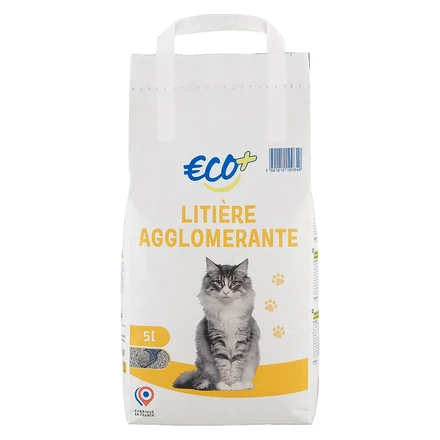
Éco+
Clumping litter 5 L
Clumping mineral — bare clay, budget brand
€1.77 the 5 L bag, i.e. €0.35/L (≈ €0.41/kg) — the cheapest of the comparison
* Absorbency, particle sizes and density not published by the brand. The price per kilo is computed on the reference density of store-brand bentonites, 800 to 900 g/L. Price recorded on 10 August 2026 at €1.77 in two E.Leclerc shops in mainland France; the chain shows no national price, so expect variation from one shop to the next.
The composition
Clumping clay (bentonite), no declared additive, no scent, no activated charcoal. E.Leclerc’s budget brand. 5 L paper bag.
❄ Our view
There is one thing the bag’s photo does not say: it is much finer than it looks. The visual suggests a medium granule; on opening, it is clay powder. We personally find it too fine, and the consequence is immediate: it makes an enormous amount of dust, on pouring as on scratching. That is the main reproach, and it is also what makes it a chore day to day: the cats scatter it everywhere, and what they scatter, they have first breathed.
The rest pleads in its favour. It clumps rather well — the grain fineness that is a problem on the dust side does a service on the clumping side. And above all, it contains nothing: no fragrance, no colouring, no blue “anti-odour” granules, no essential oil. Clay, and that is all. It does not smell of perfume, and across five trays that is a quality worth more than any packaging promise.
The price changes the scale of the problem. At €0.35 per litre, you can afford to renew a tray entirely rather than patch it up — and in a cattery, full renewal is by far the best sanitary tool. A litter five times dearer that you keep twice as long is not a saving, it is a hygiene compromise.
Our use: the trays of adults and already-weaned youngsters, with the dust as a permanent reservation. It is this litter’s paradox: the most stripped-down of the nine is also the one that poses the most problems.
Strengths
€0.35/L: nearly five times cheaper than the Tranquille
Clumps rather well, decent blocks
No scent, no additive, no colouring
Lets you renew trays entirely, more often
Available everywhere, no ordering, no pet shop
Reservations
A lot of dust: the major flaw
Grain markedly finer than the packaging suggests
No published technical data: neither absorption nor particle sizes
Kept out of the maternity tray for that reason
Bentonite: not compostable, household waste only
#5
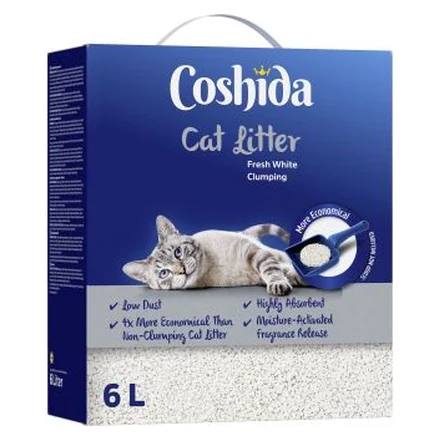
Coshida
Fresh White — scented clumping
Scented clumping mineral — 6 L
≈ €0.60/L in the 6 L box — drops to around €0.55/L on promotion
Very goodClumping
LowDust
IrritantScent
≈ €0.60Per litre
* The 6 L format hovers around €0.60/L and drops towards €0.55/L on promotion. An 8 L format appears depending on stock, at a varying price per litre — it is the litter on this page whose price moves the most from one week to the next, check the shelf label. Neither a quantified absorbency, nor particle sizes, nor the scent’s composition are published, and the chain’s product sheet, which we used to link to, has since been taken down.
The composition
White clumping bentonite, scent released on contact with moisture. The packaging claims low dust, high absorption and a consumption four times lower than a non-clumping litter.
❄ Our view
It is frustrating, because technically it is good. It clumps very well — among the best on this page on that criterion —, the blocks are firm and lift out cleanly, dust is contained, and odour control is genuinely effective. At €0.60 per litre, and less still on promotion, the value for money would be excellent.
A single point rules it out, and it is disqualifying: the scent irritates the airways. Less violently than the MultiFit’s, but clearly. You smell it pouring the bag, standing, a metre from the tray — and this product’s scent is precisely designed to release on contact with moisture, that is, at the exact moment the cat urinates, muzzle a few centimetres from the grain. The mechanism is designed for the human’s comfort, and it places the nuisance exactly where the cat cannot avoid it.
With a confident adult, it often passes. With a kitten learning its litter habits, a pregnant queen whose sense of smell is heightened, or a newly arrived cat still finding its bearings, it is a tray-refusal factor. Add the usual opacity: nobody knows what this scent contains.
Without the fragrance, it would probably be our budget benchmark. With it, it does not enter our home.
Strengths
Very good clumping, firm, clean blocks
Genuinely effective odour control
Little dust
Good price per litre, better still on promotion
Cardboard box with handle, manageable format
Reservations
Scent irritating to the airways
Moisture-triggered release: at the worst moment for the cat
Nature of the scent not communicated
No absorption figure or particle sizes published
Irregular availability and format: 6 L or 8 L depending on stock
#6
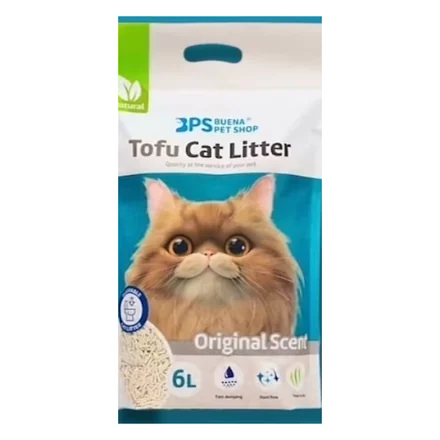
BPS
Tofu Cat Litter — Original Scent
Clumping plant-based tofu — 6 L / ≈ 2 kg
About €6 the 6 L bag, i.e. ≈ €1/L (≈ €3/kg)
PoorClumping
LowDust
NoneScent*
≈ €1.00Per litre
* The bag reads “Original Scent”, which makes you fear an added fragrance. It is not the case: in our trays this litter smells of nothing — no perfume, no marked vegetal note either. With this maker, “Original” means the neutral version, as opposed to the lemon or lavender variants in the same range. The name is simply badly chosen.
The composition
A plant-based litter made from tofu — that is, okara, the fibrous residue left over from making soy milk. The industry process usually binds that fibre with corn starch and a plant gum, but BPS publishes nothing: no percentages, no absorbency, no particle-size distribution, no bulk density. The packaging stops at five pictograms — natural, fast clumping, dust free, odour control, flushable. About 2 kg for 6 L.
❄ Our view
Let us start with what it gets right, because it is not nothing: it gives off no bad smell. No added fragrance, and none of that faintly sweetish background note some plant-based litters carry. The tray stays neutral, and dust is low when pouring — the classic plant-based advantage, and it is real here.
The problem lies elsewhere, and it is a big one: clumping is poor. Urine does not form a block but a paste, which spreads, sticks to the bottom of the tray and refuses to come away in one piece. You have to scrape, and scraping carries clean litter out with the soiled. On a product whose first packaging claim is “fast clumping”, that is precisely the promise not kept.
The useful comparison is with Lidl’s plant-based Coshida, which fails the same way one notch lower: where the Coshida disintegrates completely under the scoop, the BPS holds slightly better — enough to remove something, not enough to keep the tray clean. That is what puts it ahead, and what leaves it far behind any decent bentonite on this page.
The price does not help. At €1 per litre it costs three times the Éco+ per litre and about seven times per kilo, for a function it performs less well. The plant-based argument does not close that gap: the corn cob litter, also plant-based, clumps barely better but costs €0.67/L, and the mineral Carbonite does everything better for €0.89/L.
Two points of use, to finish. The “flushable” claim only holds on mains drainage: with a septic tank, litter does not go down the toilet. And it does not hold at all for faeces — Toxoplasma gondii oocysts have no business in the wastewater system. Like every plant-based litter, it must also be stored dry, or it will mould in its bag.
We will not keep it as a main litter. It stays usable for the specific cases where neutrality matters more than a clean tray — transport, post-operative recovery, a cat with fragile airways — but on that ground the corn cob does as well for less.
Strengths
No bad smell, no added fragrance despite the “Original Scent” label
Low dust when pouring
Plant-based and biodegradable
Very light: about 2 kg for 6 L
Plant fibre: accidental ingestion is less of a problem than with sodium clay
Reservations
Poor clumping: urine makes a paste, not a block
The paste sticks to the bottom of the tray and forces you to scrape
≈ €1/L and ≈ €3/kg: three times the Éco+ per litre, about seven times per kilo
No technical data published at all: no figures for composition, absorbency or particle size
“Flushable”: never with a septic tank, and never with faeces
Vulnerable to damp in storage
No stable retail presence in France: irregular availability
#7
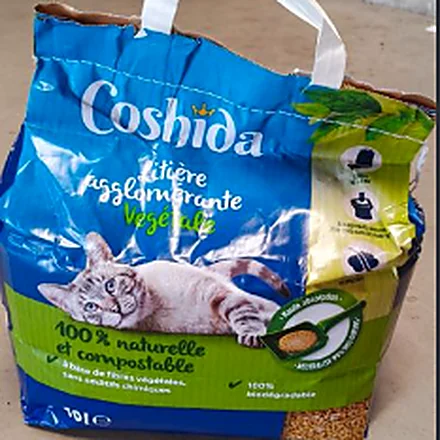
Coshida Végétale
Plant-based clumping litter
Plant-based clumping — 10 L
No price found online: a seasonal reference, with no sheet and no tariff published
Very poorClumping
NoneDust
NoneScent
n/aPer litre
* This is, with the BPS tofu, one of the two litters on this page for which nothing is published anywhere: no absorbency, no particle size, no exact fibre, not even the weight of the bag. Everything below comes from the packaging and from our trays. It is also the only sheet on this page without a price per litre: the 10 L format only appears depending on stock, no tariff is published online, and we did not keep the receipt. We will add it on our next trip to the store.
The composition
Plant-based clumping granules, pale sticks. The packaging claims “100 % natural and compostable”, “made from plant fibres, with no chemical additives” and “100 % biodegradable”. The plant itself is not named — wood, corn, soya or paper, we will not know.
❄ Our view
On paper it ticks our whole grid: plant-based, no scent, no colouring, no dust. And the odour control is genuinely effective — the tray does not smell, and that is what it does best.
It still misses the essential. It does not clump. Or rather, it gives the illusion of clumping: instead of the firm block you lift in one movement, urine forms a semi-soft paste that crumbles under the scoop, leaves half of itself at the bottom of the tray and sticks to the sides. On a product sold as clumping, that is not a secondary flaw — it is the missing function.
The rest follows: what does not clump gets scattered. The granules leave on paws and end up well beyond the tray. It makes no dust — the classic advantage of plant litters, and it is real — but it still gets everywhere, in another way.
The most telling comparison is within the brand itself. The mineral Coshida does everything better: firm blocks, clean removal, odour control at least as good. The one reproach we make of it, its scent, does not exist here — but we trade a serious flaw for a disqualifying one. And the two budget bentonites on this page, Action’s Beasty and the Éco+, also clump very well, at €0.50 and €0.35 per litre: their flaw is dust, not clumping.
We will not buy it again. The principle of a plant-based clumping litter is not what is at fault — this particular reference simply does not keep its promise.
Strengths
No scent, no colouring
Genuinely effective odour absorption
No dust at all
Plant-based, compostable and biodegradable
Carry-handle bag, easy to move and to close again
Reservations
Very poor clumping: a semi-soft paste, not blocks
The mass crumbles under the scoop and leaves half in the tray
Heavy scattering outside the tray
The same brand’s mineral litter does better
No product sheet published, no technical data, no price online
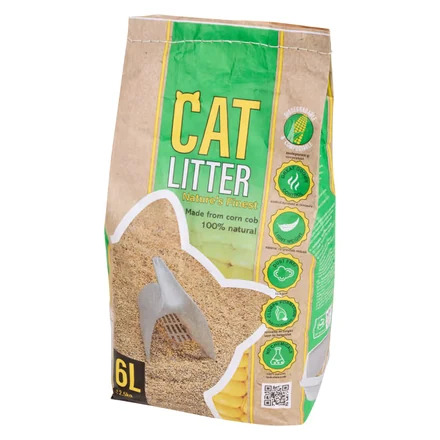
* This is where the price per litre misleads the most: 6 L weigh only 2.5 kg, against about 5 kg for an equivalent volume of bentonite. Per litre, this litter looks twice as dear as the Éco+; per kilo, it is four times dearer. On the other hand, a thinner layer suffices.
The composition
100 % ground corn cob — the non-edible core of the ear, an agricultural co-product. No chemical additive, no colouring, no scent. Biodegradable and compostable. Absorbency not published on the packaging.
The grain, in the hand: light, irregular, markedly bigger than a bentonite. That calibre explains both the absence of dust and the scatter outside the tray.
❄ Our view
The weak point is clear and we must start with it: clumping is middling, and above all slow. The urine blocks form, but in use they are uneven: under the stainless scoop, some hold in one piece, others fall apart at once. You carry clean matter away with the soiled, fresh clumps stick to the bag when thrown out, and the tray degrades faster than with a good bentonite. On heavily used trays, that is a real constraint.
That slowness has a direct consequence in an automatic litter box: the matter is compatible with a robot, but we set ours on thirty-minute cycles, and at that pace the clumps visibly lack the time to harden — the rake breaks part of them. Usable, then, provided the cycles are clearly spaced and you accept a less clean sort; with a fast rotation, a bentonite remains better suited.
Against that, two very good surprises. Odour control is excellent: on our trays, nothing escapes, absolutely nothing — the cob seems to hold urine odours remarkably, better than we expected of a plant litter without a single additive. And it makes no dust — not “little”, none: it is the only one on this page whose whole bag can be poured without the slightest cloud — the BPS tofu comes close, without matching it. Which makes it precious where the Éco+ is ruled out: post-surgery, transport, and any cat with fragile airways. If a kitten swallows some — they all do — we are talking plant fibre, not sodium clay that swells on contact with liquids.
It is also very light, 2.5 kg for 6 L, which is not nothing when setting up a tray in a carrier or at the vet’s. The flip side: the grains fly. A cat that scratches energetically sends them out of the tray, and a thick-coated Ragdoll walks out with grains all over its breeches.
A point of vigilance that holds for every plant litter: store the bag dry. Damp plant matter can go mouldy, and a bag forgotten in a damp garage has no business in a tray any more.
All told: too weak on clumping to be our main litter, precious for the precise use we reserve it for.
Strengths
No dust: the only one on the page in that case
Excellent odour control: nothing escapes the tray
Plant fibre: accidental ingestion far less problematic
Gentle under the little ones’ paw pads
Biodegradable and compostable, an agricultural co-product
Very light: 2.5 kg for 6 L, practical in transport
Reservations
Slow, uneven clumping: some blocks fall apart under the scoop, others stick to the bag
€1.60/kg: four times the price of the Éco+ at equal matter
Light grains that leave the tray and cling to long coats
Fears damp in storage: mould risk
In an automatic box: demands spaced cycles, or the rake breaks the blocks
No absorption data published
#9
MultiFit
Fresh Comfort — scented clumping
Scented clumping mineral — 20 L
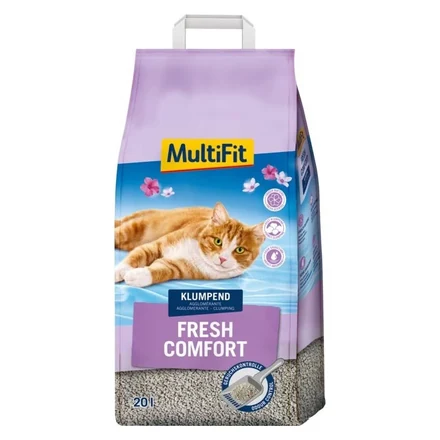
€15.99 for 20 L, i.e. €0.80/L (€0.71/L in a two-bag bundle)
* Price recorded on maxizoo.fr in August 2026, under a “low price” badge: €15.99 for 20 L, or €28.39 for two bags (€0.71/L). Average rating on the same sheet: 3.5 out of 5 over more than 1,300 reviews — the lowest of the shelf’s MultiFit litters, whose Ultra Comfort 15 L reaches 4.3 for the same price per bag.
The composition
Scented clumping mineral litter. The brand describes it as an entirely natural product and recommends a depth of at least 5 cm with a full renewal every two weeks. Neither the nature of the clay, nor the absorbency, nor the scent’s composition is published.
❄ Our view
It is, with the plant-based Coshida and the BPS tofu, one of the three litters on this page we would not buy again, even as a stopgap, and here the reason holds in one word: the scent is far too strong. It is the most aggressive of the nine, far ahead of the Coshida. Opening the bag is enough; filling a tray in a closed room is frankly unpleasant, and the airway irritation is immediate. On a product meant to carpet the floor where a cat will bury its muzzle several times a day, that is a contradiction in terms.
The rest redeems nothing. Clumping is fair at best, dust medium, and the price puts it at more than double the Éco+: €15.99 for 20 L, i.e. €0.80 per litre, and €0.71 only if you take two twenty-litre bags at once. You therefore pay more for a flaw.
The product sheet is otherwise remarkably empty: “entirely natural” means nothing on a litter — clay, corn, wood and silica are all natural — and none of the data that would allow comparison is given. The user rating follows: 3.5 out of 5 over more than 1,300 reviews, the lowest of the chain’s litter shelf.
Its only argument remains the 20 L format, the only large packaging of the comparison. It is not enough.
Strengths
20 L format: the only large packaging of the comparison
One bag covers several trays, less handling
Fair clumping
Reservations
Scent far too strong, irritating to the airways
€0.80/L: more than double the Éco+, for a less neutral product
3.5/5 over 1,345 reviews, the shelf’s lowest rating
Product sheet with no technical data at all
“Entirely natural”: a phrase that means nothing here
Sold in pet shops only
Clumping litters: what is true, what is not
You regularly read that clumping litters are toxic, that a chemical reaction happens on contact with urine. We wanted to check, because the claim seemed to us both too broad and not completely false. Here is what we found — each point opens on a click, and the sources are at the bottom of the page.
It is the most useful finding of this research, and it explains everything else. In France, no regulatory text applies to the substances entering pet litters. The AFNOR standard NF V 19-001, the one some packagings cite, was created precisely to fill that void: it is a voluntary standard, published in 1993 from the trade body’s own proposals. It frames labelling — absorbency, density, pH, particle sizes — but not composition.
In other words: a litter manufacturer has no obligation to tell you what is in the bag. Those who publish their composition do so by choice. It is the exact opposite of food, where European regulation 767/2009 imposes the full ingredient list. Of the nine litters on this page, three publish their composition in percentages, six stick to general formulas or say nothing at all.
Bentonite swelling on contact with urine is a physical phenomenon: the clay absorbs the liquid and expands. No new molecule is created. As for the ammonia smell of a poorly kept tray, it comes from the bacterial degradation of urea — and that happens in every litter, clumping or not, mineral or plant. That particular grievance does not hold.
A study by the mineralogical analysis laboratory of the Saint-Joseph Saint-Luc hospital in Lyon, led by Dr Michel Vincent, a pulmonologist, measured the fine particles emitted at the moment of pouring into the tray: PM10 concentrations exceeding 20,000 µg/m³, against a recommended threshold of 100 µg/m³. That dust contains crystalline silica, which the International Agency for Research on Cancer classifies as a group 1 carcinogen.
Three precisions, because that figure circulates everywhere without its context. The IARC classification concerns prolonged occupational exposure, quarry- or worksite-style, not filling a cat tray. It was a measurement campaign in a few households, not an epidemiological study. And it also covered silica litters, not only clumping ones. That does not invalidate it: it resizes it. The risk is real; its magnitude in domestic use is not quantified.
What to retain, above all: the grievance does not target clumping, it targets grain fineness. A coarse-grain bentonite and a powdered bentonite are two very different products on that criterion, even if the label says “clumping” in both cases. That is exactly why particle sizes interest us more than the marketing claim.
The argument is well known: sodium bentonite swells up to fifteen times its volume, so a kitten that swallows some risks an obstruction. Tracing it to the source, one finds an article by an American holistic practitioner from the 1990s reporting observed cases — and, since then, no controlled study. The veterinarians who have looked at the question say it themselves: the reports are anecdotal, and if a risk exists, it is probably not very high.
That does not change our caution. The recommendation remains to avoid clumping bentonite with very young kittens and with cats that eat what is not food: the benefit-risk ratio of a few-euro litter does not justify playing with that. With kittens over three months, on the other hand, the reservation largely falls away — they are past the stage of mouthing everything, and that is the age we are talking about throughout this comparison.
The phrase appears on several packagings, including the Tranquille’s. It is a little hollow, since the regulation in question, on composition, does not exist. What really applies is the European CLP-REACH regulation: if the adjuvant were a substance classified as hazardous, a pictogram would have to appear on the box. That is the case for none of the litters on this page.
On what it probably is: the sector’s patents show that the additives used to reinforce clumping are food-grade thickeners — guar gum, xanthan gum or sodium carboxymethylcellulose — incorporated at 0.25 to 0.5 % of the mix. Nothing worrying. But we deduce it from the state of the art, not from a label: the manufacturer does not say.
It is the most counter-intuitive lesson of this comparison. The Éco+ is the most stripped-down litter of the nine: clay, nothing else, no additive, no scent, no colouring. On paper, it is the most “natural”. And yet it is the one that poses the most problems, because it is so fine that it maximises exactly what is documented as a risk — particle emission. It clumps well, it makes handsome urine blocks, it smells of nothing. But it powders, it is a chore to clean, and the cats walk out with loaded paws.
“Natural” and “harmless” are not synonyms. It is the same reasoning as on our dry-food comparison: what counts is what the product does, not what the packaging promises.
Our grid, in the end
It holds in three refusals, and they are more operative than the clumping / non-clumping divide:
No dust. It is the only genuinely documented risk. Incidentally, it is also what makes a litter a chore: the cats spread it everywhere, and what they spread, they have first breathed.
No scent. A litter is not supposed to smell nice. Wanting to perfume a tray is like wanting to perfume a toilet: you fix nothing, you add one smell to another. A product that absorbs odours, yes; a product that covers them, no. And if the fragrance bothers us a metre from the tray, it necessarily bothers the cat with its muzzle in it.
No colours. Blue granules, fluorescent crystals, tinted grains: none of those colours exists in a clay or a plant fibre. They signal an addition that nothing obliges the manufacturer to declare.
A last remark on method. Among the most alarmist sources on mineral litters, many are brands that sell plant litter. That does not make their figures wrong — but their enthusiasm for the 20,000 µg/m³ threshold is not disinterested, and we prefer to flag it.
Clumping or not? Why we choose clumping
The question comes up often, and it is badly put: it is not a moral choice, it is a choice of use. Here is ours, and its limits.
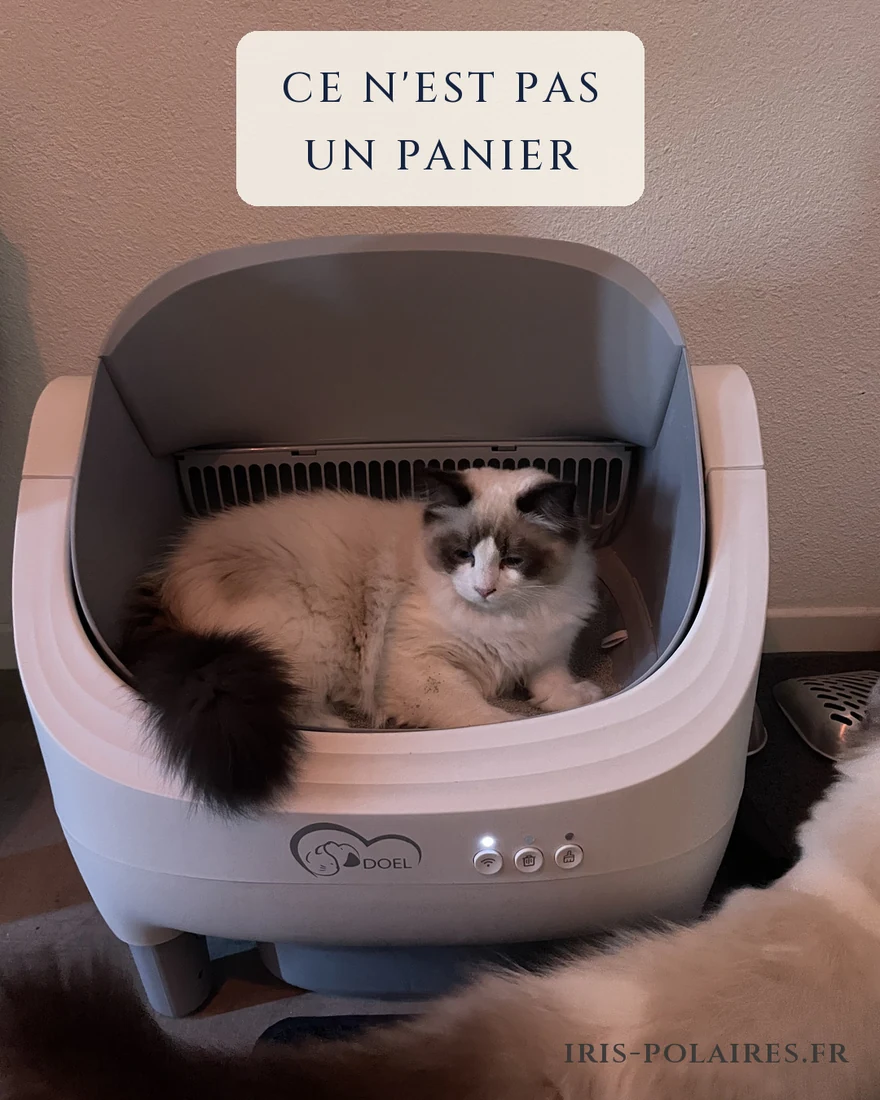
Bijou found the automatic litter box a use the manufacturer had not foreseen.
That is the whole point, and it is often forgotten because one thinks first of the stools. In a non-clumping litter, the droppings can be scooped; the urine, for its part, sinks to the bottom of the tray and stays there until the full change. It degrades there, it makes ammonia there, and that is where the smell of a supposedly clean tray comes from. A clumping litter turns that urine into a block removed with the rest. The tray stays sound longer, for less upkeep.
We use an automatic box that triggers some thirty minutes after the cat’s visit and evacuates the waste by rotation. That type of device can only work with a clumping litter: the mechanism sorts solid blocks, it can do nothing with diffuse urine. Some manufacturers state it explicitly — the Fleur de Litière and the Carbonite both carry the words “compatible with automatic litter boxes”. If you equip your cat with a box of this type, the choice is therefore constrained: it will be a clumping litter.
Daily manual cleaning exposes you to two things: the dust discussed above, and zoonoses. On that second point, a detail of the Toxoplasma gondii cycle deserves to be known: the oocysts shed in a cat’s stools are not infectious at the moment they come out. They need 24 hours to 5 days of sporulation in the environment to become so. That is exactly why the medical recommendation is to empty the tray daily: you remove the stools before they present a risk.
An automatic box that evacuates thirty minutes after the visit therefore does better than daily cleaning, and without handling. For a pregnant or immunocompromised person living with cats, that is no gadget.
A new cat’s first days: a manual tray, without exception. A newcomer must be watched — has it urinated? has it defecated? what do the stools look like? A stressed cat holding on for 48 hours, a food-change diarrhoea, a parasite declaring itself: all of that shows in the tray and nowhere else. A machine that evacuates before you have looked erases the very information you need most. The automatic box comes after, once the routine is settled.
The very young: no clumping mineral, and we stop there. A kitten of a few weeks tastes everything, its litter included, and that is where the reservation on sodium bentonite takes its meaning; cattery practice is to keep the tray by hand, with a non-clumping or plant litter. We will not detail further, for a simple reason: our first litters are expected in 2027 and we have not yet settled a maternity protocol. Everything above on this page describes what we practise with adults and with youngsters over three months, weaned and adoptable. We will complete this page when we have real experience of newborns, not before.
What to remember
Tranquille La Carbonite — our new reference. Very firm clumps, the best odour control on the page, no scent, and about €0.89 per litre. It does the Fleur de Litière’s job for roughly half the price.
Tranquille Fleur de Litière — technically faultless, and marginally better on paper (absorbency, grain fineness). Its only flaw is the price: €1.62 per litre, nearly five times the Éco+ and double the Carbonite.
Beasty (Action) — no highlight, but no failure either: little dust, no scent, decent clumping, €0.50/L. Its weak point, fairly mediocre odour control.
Éco+ 5 L — unbeatable on price and perfectly neutral, but far finer than its bag suggests, hence very dusty.
Coshida Fresh White — technically the best cheap bentonite on the page, ruled out for its irritating moisture-released scent.
BPS Tofu Cat Litter — no bad smell, little dust, and a clumping action that is not one: urine makes a paste that sticks to the bottom of the tray. At ≈ €1/L it costs three times the Éco+ to do less well.
Coshida plant-based 10 L — no scent, no dust, and very low all the same: it does not clump at all, it makes a soft paste that crumbles under the scoop.
Corn-cob litter — disappointing clumping, but no dust and no scent. A litter for a precise use, not a main litter.
MultiFit Fresh Comfort 20 L — the most aggressive scent of the nine, for more than double the Éco+’s price. Last, and by some distance.
Of these nine litters, only one ticks more or less every box, and it is the newcomer: the Carbonite holds its clumps, holds the odours, smells of nothing and stays on the right side of reasonable per litre. It is what fills our trays today. The Fleur de Litière remains the best product of the lot on paper — but we no longer see what would justify paying double. As for the tofu, it was the trial we had been announcing here since the summer: it is done, and it will not be bought again.
One last point that holds for all nine: the best litter in the world does not replace trays big enough and numerous enough. One tray per cat plus one, placed somewhere quiet, away from the bowls and away from one another — that is what settles the great majority of litter problems, well before the choice of granule.
Sources
official product sheets Tranquille — Fleur de Litière · Tranquille — La Carbonite · E.Leclerc · Action · Action — Beasty · Lidl · BPS Buena Pet Shop · Maxi Zoo. Reference densities for bentonite (800 to 900 g/L) from the technical sheets published by store brands. The appraisals of clumping, dust and scent are our own, after use in our trays. Prices recorded in August 2026 on the linked sheets, brought back to the litre for the stated format; they vary strongly from one chain and one week to the next, and manufacturers change their formulas without notice — always check the packaging in your hand.