Skip to content
Chatterie des Iris Polaires
Explore further

Dry-food comparison

Five brands, six kibbles put under the microscope: composition, protein, carbohydrates, additives and value for money. No partnership, no commercial tie — we buy everything we test.

Image to come
The hard part is not choosing the kibble — it is convincing the lady in question.

Our first criterion: proof. A label says what the manufacturer puts in the bag; it does not say what the cat gets out of it. So we rank first the brands that can prove what they claim: a board-certified veterinary nutritionist, feeding trials carried out on animals, and verifiable quality control of the finished product, protein included. These are the questions that WSAVA, the World Small Animal Veterinary Association ↗, advises asking a manufacturer. It is also the opinion of Dr Pierre Bessière, veterinary researcher at the Toulouse National Veterinary School (ENVT), consulted in October 2026. Composition comes next, as the tie-breaker. Our criteria and each brand’s evidence are detailed in Choosing a dry food: FEDIAF and WSAVA.

The reviews are ranked from the one we choose to the one we set aside. Each header gives the essentials; the detail — figures, first ingredients, our view, strengths and reservations — opens on a click.

Two bearings for reading these figures. First, the protein rate says nothing about its origin: 36 % protein of which half comes from wheat gluten does not have the same value as 36 % animal protein. Second, carbohydrates are almost never declared — we compute them by difference, an approximate method but comparable from one product to the next. The cat is a strict carnivore: it has no physiological need for carbohydrates, even if starch remains indispensable to manufacturing a kibble.

The reference thresholds are those of the FEDIAF nutritional guide ↗ (PDF in French; an English edition exists on fediaf.org): for growth, 28 % protein and 9 % fat on dry matter at minimum. Every kibble on this page exceeds them — which is exactly why merely meeting the minimums is not enough to separate them.

#1
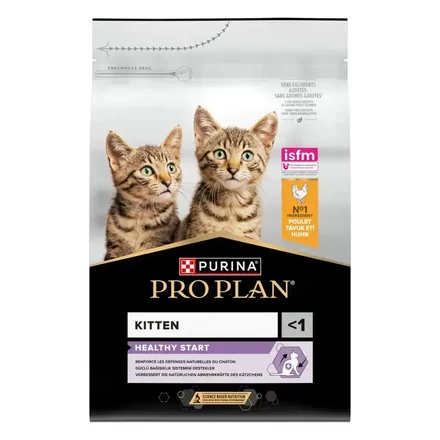
Purina Pro Plan Kitten Healthy Start with chicken, kibble for kittens

Purina Pro Plan

Kitten Healthy Start — Chicken

Dry food — kitten from 1 to 12 months

≈ €13/kg (3 kg bag)

See the product sheet on purina.fr ↗
40 %Protein
20 %Fat
25.5 %Carbs*
n/akcal/kg

* Carbohydrate rate published by the manufacturer — rare enough to be worth noting. The energy value, however, is not stated on the French product sheet.

The first ingredients

Chicken (20 %), dehydrated poultry proteins, rice, wheat gluten, animal fats, maize, maize protein meal, pea proteins, maize starch, dried eggs.

❄ Our view

This is our first choice. Purina is one of the manufacturers that carry out their own research and check the quality of their foods once made: what the label says is verified. The food is technically solid, far above the FEDIAF growth minimums, with DHA, colostrum at 0.10 % and high taurine.

Against Royal Canin, composition makes the difference. Chicken is the first ingredient (20 %), ahead of rice, whereas Royal Canin opens with rice. The protein rate is higher (40 % versus 36 %), and carbohydrates, published by the manufacturer, stay lower (25.5 % versus about 28 %).

The composition is not perfect for all that. Of the first ten ingredients, five are cereals or derivatives: rice, wheat gluten, maize, maize protein meal, maize starch — to which pea proteins are added. 25.5 % carbohydrates is a lot for a strict carnivore.

Part of the 40 % protein also comes from wheat and maize gluten, incomplete plant proteins devoid of taurine — hence the need to add it. The truly animal protein rate is therefore below the label figure.

The additive list is otherwise limited to vitamins A, D3, E and C and six trace elements, without the B group. For a food tested once manufactured, this matters less: it is the analyses of the finished product, not the additive list, that show the needs are covered.

Strengths

  • Manufacturer with its own research department, food tested after manufacture
  • Animal feeding tests using AAFCO procedures (stated on the bag)
  • Chicken as first ingredient, ahead of rice
  • 40 % / 20 %: far above the FEDIAF growth thresholds
  • DHA 0.05 %, colostrum 0.10 %, high taurine
  • Also suitable for pregnant and nursing queens
  • Carbohydrate rate published by the manufacturer, which is rare
  • Consistent manufacturing quality, easy availability

Reservations

  • Five grain derivatives among the first ten ingredients
  • Carbs 25.5 % — high for a strict carnivore
  • A notable share of the protein comes from wheat and maize gluten
  • Limited additive list: no B-group vitamins
  • Only 20 % fresh chicken
#2
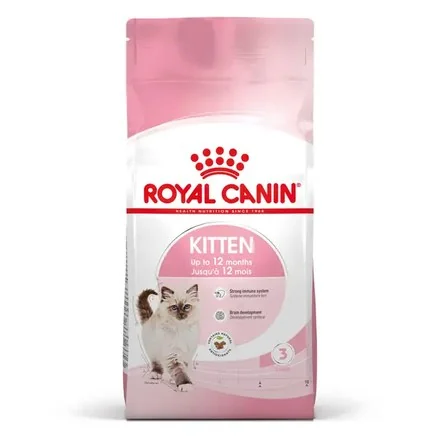
Royal Canin Kitten — kibble for kittens up to 12 months

Royal Canin

Kitten range

Dry food — kitten up to 12 months

≈ €13/kg (4 kg bag)

See the product sheet on royalcanin.com ↗
36 %Protein
18 %Fat
~28 %Carbs*
4083kcal/kg

* Carbohydrates not stated by the manufacturer — computed by difference (~30 % on dry matter).

The first ingredients

Rice, dehydrated poultry proteins, wheat gluten, animal fats, maize flour, hydrolysed animal proteins, wheat flour, maize gluten, beet pulp, yeasts.

❄ Our view

Second in our ranking, with the same guarantee as Pro Plan: Royal Canin carries out its own research and checks the quality of its foods once made. It comes after Pro Plan on composition: rice comes first, before any animal source, with less protein (36 % versus 40 %) and slightly more carbohydrates (about 28 % versus 25.5 %).

A complete, clinically formulated food that far exceeds the FEDIAF growth minimums (28 % protein and 9 % fat on dry matter): here we sit around 39 % protein and 20 % fat on dry. It also answers the kitten’s specific needs — DHA for brain and visual development, vitamins E and C for immunity, prebiotics (MOS) and highly digestible proteins for the microbiome.

The caveat lies in a very cereal-heavy list: rice, wheat gluten, maize flour, wheat flour and maize gluten all sit among the first eight ingredients. Hence a carbohydrate rate of about 28 % — moderate for a dry kibble (starch is needed to manufacture it), but high for a strict carnivore, which has no physiological need for carbohydrates. FEDIAF, incidentally, sets no maximum on this point.

Another consequence of those cereals: part of the displayed protein comes from wheat and maize gluten, plant proteins less complete than an animal protein and devoid of taurine. The truly animal protein rate is therefore below the announced 36 %.

Strengths

  • Manufacturer with its own research department, food tested after manufacture
  • Clearly exceeds the FEDIAF growth thresholds
  • DHA, vitamins E + C, MOS prebiotics (brain, immunity, digestion)
  • Very digestible, clinical formulation, consistent quality
  • Kibble shaped for a kitten’s small jaw
  • Energy value published, which few brands do

Reservations

  • Very cereal-heavy list (5 grain derivatives in the top 8)
  • Carbs ~28 % — high for a strict carnivore
  • Part of the protein is plant-based (wheat and maize gluten)
  • Rice is the very first ingredient, before any animal source
#3
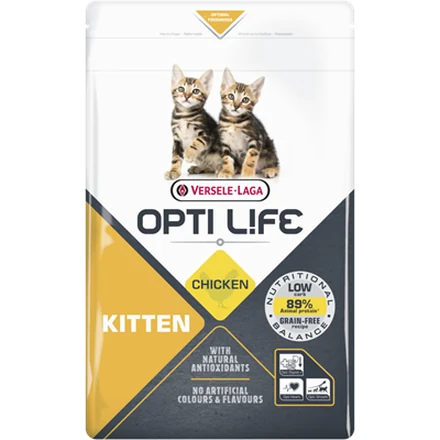
Opti Life Kitten with chicken, grain-free kibble for kittens

Opti Life

Kitten — Chicken

Dry food — growing kitten

≈ €7.90/kg (2.5 kg bag)

See the product sheet on versele.com ↗
40 %Protein
20 %Fat
~20 %Carbs*
n/akcal/kg

* Carbohydrates estimated by difference — Versele-Laga does not declare the moisture, the estimate assumes 8 %. The energy value is not published on the product sheet.

The first ingredients

Chicken (dehydrated, 49 %), potato, animal fats, peas, plant fibres, hydrolysed animal proteins, salmon, salmon oil (1 %), brewer’s yeast.

❄ Our view

On paper, this is good work: grain-free, dehydrated chicken at 49 % heading the list, 89 % animal protein announced, and a 40/20 ratio exactly on target for a growing kitten. Carbohydrates hover around 20 %, the lowest rate on this page.

Our reservation bears on two points. First, “grain-free” does not mean “carb-free”: the potato and peas that replace the rice are still starch, and 20 % for a strict carnivore is not nothing. The marketing promise is a little more generous than the analytical reality.

Second, and this is what bothers us most, the additive list is short: vitamins A, D3, E and C, a few trace elements, taurine and L-carnitine. No B-group vitamin appears, nor biotin, nor folic acid, nor choline — all nutrients the FEDIAF guide lists for growth. They may be supplied by the raw materials, but nothing on the label allows it to be checked. It is a good kibble with things missing.

Strengths

  • Grain-free, dehydrated chicken 49 % as first ingredient
  • 89 % of protein animal-sourced (announced)
  • 40 % / 20 %: ideal ratio for growth
  • Carbs ~20 %, the lowest rate of the comparison
  • FOS and MOS, salmon oil (EPA + DHA), taurine 2,000 mg/kg

Reservations

  • Incomplete additive list: no B vitamins, no biotin, no choline
  • Neither moisture nor energy value declared
  • “Low-carb”: 20 % potato and pea starch is not zero
  • Hydrolysed animal proteins not detailed
#4
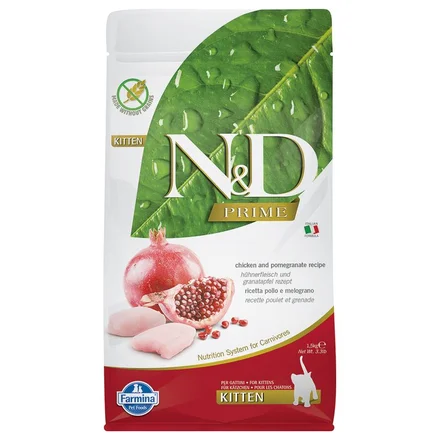
Farmina N&D Prime Chicken & Pomegranate Kitten, dry food for kittens

Farmina N&D

Prime — Chicken & Pomegranate Kitten

Dry food — kitten

≈ €21.33/kg (1.5 kg bag)

See the product sheet on zooplus.fr ↗
44 %Protein
20 %Fat
~18 %Carbs*
n/akcal/kg

* Carbohydrates calculated by difference from the published analytical constituents (protein 44 %, fat 20 %, crude fibre 1.8 %, moisture 8 %, ash 8.5 %). The energy value is not given on the sheet consulted.

The first ingredients

Boneless chicken (30 %), dehydrated chicken protein (28 %), sweet potato, chicken fat, dehydrated eggs, herring, dehydrated herring protein, herring oil, pea fibre.

❄ Our view

On the label, this is the finest composition on this page: boneless chicken (30 %) and dehydrated chicken protein (28 %) at the top of the list, grain-free, 44 % protein and about 18 % carbohydrates. Farmina also publishes the most complete additive list of the comparison, and cultivates an image built around science, research and natural ingredients.

Put through WSAVA’s five questions, the brand meets only two. It owns its factories, and it formulates its recipes to AAFCO and FEDIAF nutrient profiles with an in-house scientific team: a veterinarian with a PhD in nutrition heading formulation, chemists, biologists, and a link with the University of Naples Federico II.

The other three are not met. Farmina does not employ a full-time board-certified veterinary nutritionist (DACVIM-Nutrition or ECVCN), unlike Royal Canin, Purina or Hill’s. Its recipes do not go through animal feeding trials following AAFCO procedures: the bags say “formulated to meet”, not “animal feeding tests”, whereas the Pro Plan Kitten bag does state “animal feeding tests using AAFCO procedures”. Finally, the announced checks on the finished product (NIR analysis, batch traceability) remain internal, unpublished and without independent verification.

That is the key point. “Formulated to meet” guarantees the right amounts of nutrients, on paper. It says nothing about the real quality of the protein or its digestibility, which is precisely what can explain digestive problems with an otherwise comparable composition. Dr Pierre Bessière, veterinarian (DVM, PhD) at the Toulouse National Veterinary School (ENVT), does not recommend this brand: in his view, it is unable to prove its claims or to run serious checks on protein quality once the kibble is made. Hill’s, Pro Plan, Royal Canin, Advance, Virbac and Specific can.

Our own trial points the same way. For almost three months, from the end of July, our three cats ate Farmina N&D Ancestral Grain, and all three had persistent diarrhoea. In the two young ones, stools turned liquid again as soon as we removed the psyllium: we checked this three times. None of them had the problem on Pro Plan or Royal Canin. Stool tests are under way at the Toulouse National Veterinary School to rule out a parasitic cause. The brand’s sales representative, asked several times, never managed to give us an answer. We no longer use Farmina.

Then there is the price: €21.33/kg for this kitten range in a 1.5 kg bag, the dearest in the comparison. To get down to around €6/kg in a 10 kg bag, on a par with Pro Plan, you have to go through a sales representative who enters every order by hand: a cumbersome process that brought us no nutritional information. A food sold as premium, without the proof to match: we advise against it.

Strengths

  • Boneless chicken (30 %) and chicken protein (28 %) at the top of the list
  • Grain-free, 44 % protein, carbs ~18 %
  • The most complete declared additive list on the page
  • Own factories and an in-house scientific team
  • No artificial preservatives

Reservations

  • No AAFCO feeding trials: recipe “formulated to meet”
  • No board-certified veterinary nutritionist on staff full-time
  • Finished-product checks internal and unpublished
  • Persistent diarrhoea in our three cats
  • €21.33/kg in a 1.5 kg bag; lower rates only through a sales representative
#5
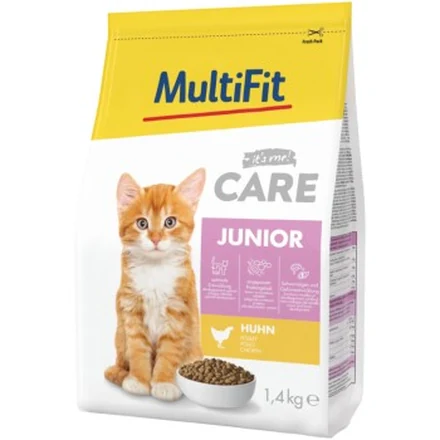
MultiFit Care Junior with chicken, kibble for kittens, Maxi Zoo brand

MultiFit Care

Junior — Chicken

Dry food — kitten from 2 to 12 months

≈ €5.80/kg (1.4 kg bag)

See the product sheet on maxizoo.fr ↗
38 %Protein
17 %Fat
~26 %Carbs*
n/akcal/kg

* Carbohydrates estimated by difference — moisture not being declared, the estimate assumes 10 %. The energy value is not published.

The first ingredients

Meat and animal by-products (including 26 % chicken protein, 5 % fresh poultry), cereals, oils and fats (including 0.5 % salmon oil), plant by-products, minerals, vegetables, yeasts.

❄ Our view

Distinctly above the classic MultiFit, and it must be said: the list here opens with animal matter, not cereals, and 26 % chicken protein plus 5 % fresh poultry are identified — against 4 % on the standard version. The figures follow: 38 % protein, 17 % fat, about 26 % carbohydrates. It is a different product.

Cereals remain in second position, and the label “meat and animal by-products” still does not say which species are involved beyond the identified chicken. We stay, therefore, in partial transparency.

The real problem lies elsewhere, and it is serious: the additive list is limited to vitamin D3, taurine and four trace elements. No vitamin A, no vitamin E, no vitamin C, no B group, no DHA. On a growth food, that is very short — even granting that the raw materials supply part of it, nothing allows it to be verified.

Our verdict: at comparable prices in the budget segment, it is the better of the two MultiFits, and the value for money is real. It is still not what we would choose for a Ragdoll kitten, whose growth stretches over three to four years.

Strengths

  • Animal ingredients at the top of the list, before cereals
  • 26 % chicken protein + 5 % fresh poultry identified
  • 38 % / 17 %: a decent profile for growth
  • Carbs ~26 %, seven points below the standard version
  • Salmon oil, inulin, taurine 1,250 mg/kg
  • Very good value for money in its segment

Reservations

  • Very short additive list: no vitamin A, E, C or B group
  • No declared DHA
  • Cereals as second ingredient, not detailed
  • “Meat and animal by-products”: species not named
  • Small formats only (750 g and 1.4 kg)
#6
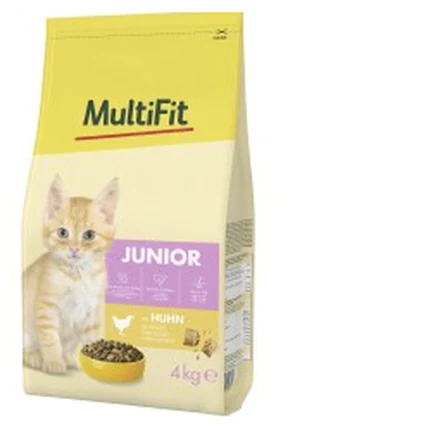
MultiFit Junior with chicken, kibble for kittens, Maxi Zoo brand

MultiFit

Junior — Chicken

Dry food — kitten from 2 to 12 months

≈ €2.50/kg (4 kg bag)

See the product sheet on maxizoo.fr ↗
35 %Protein
13 %Fat
~33 %Carbs*
n/akcal/kg

* Carbohydrates estimated by difference — moisture not being declared, the estimate assumes 10 %. Neither the energy value nor the detail of the raw materials is published.

The first ingredients

Cereals, meat and animal by-products (including 4 % chicken protein in the round kibble), plant by-products, oils and fats, vegetables, minerals.

❄ Our view

We include it because the question comes up often, and the answer must be frank: it is the weakest of the comparison. The first ingredient is “cereals”, in the plural and without precision, followed by “meat and animal by-products” of which only 4 % chicken protein is identified. The rest of the animal origin is not named, which forbids any verification.

The announced 35 % protein must therefore be read with caution: without knowing what is animal and what is plant, the figure says little. Fat at 13 % is moreover low for a growing kitten, and carbohydrates hover around 33 % — the highest rate on this page.

The additive list boils down to vitamins A, D3 and E, taurine at 1,200 mg/kg and four trace elements. No vitamin C, no B group, no DHA.

It is not a dangerous food, and it ticks the regulatory minimums. It is simply the classic profile of a store brand: cheap, opaque. For a kitten in full growth — a fortiori a Ragdoll, which grows until three or four — we do not recommend it.

Strengths

  • The cheapest of the comparison
  • Covers the regulatory growth minimums
  • Added taurine, no added sugar or colourings
  • Available everywhere in Maxi Zoo shops

Reservations

  • “Cereals” as first ingredient, without precision
  • Only 4 % chicken protein identified
  • Animal origin not named: no verification possible
  • Fat 13 % — low for growth
  • Carbs ~33 %, the highest rate of the comparison
  • No DHA, no vitamin C, no B-group vitamins

Sources

official product sheets Farmina · Versele-Laga · Royal Canin · Purina · Maxi Zoo · FEDIAF, nutritional guide · WSAVA, Guidelines on Selecting Pet Foods (2021) · Dr Pierre Bessière (DVM, PhD), Toulouse National Veterinary School, by email, 12 October 2026. Prices recorded in August 2026 (October 2026 for Farmina) on the linked sheets, brought back to the kilo for the stated format. Manufacturers change them without notice — always check the bag in your hand.

FEDIAF, AAFCO and WSAVA: how we rank

All six kibbles meet the FEDIAF minimums: that filter alone does not separate them. We then count the WSAVA criteria each manufacturer documents publicly (who makes it, who formulates it, board-certified veterinary nutritionist, feeding trials, verifiable quality control), then composition and our observations. Feeding trials show on the American label, in the AAFCO statement: Pro Plan Kitten passed them, Royal Canin Kitten and Farmina N&D are only “formulated to meet” (AAFCO explained).

The criteria and the evidence, brand by brand

What to remember

One last point that holds for all six: no dry kibble replaces water. A cat that eats only dry food rarely drinks enough. We systematically pair it with a share of wet food, and we talk about it on our page Feeding your Ragdoll well.

The jury, for its part, does not read labels

Every figure on this page goes through a second check, distinctly less negotiable: Bijou, Brontë and Aranel. A kibble can be perfect on paper — if the bowls stay full, the verdict is in, and it is final.

To know who is judging: come and meet our three Ragdolls — their profiles, their pedigrees and their (many) photos.

Explore further

Other kibbles will be compared progressively, with the same method. A question about feeding a kitten? Write to us.