Skip to content
Chatterie des Iris Polaires
Explore further

Probiotics comparison

Five products sold on the same “intestinal comfort” shelf. Only three contain living bacteria. Here is how to tell them apart, and what each is really worth.

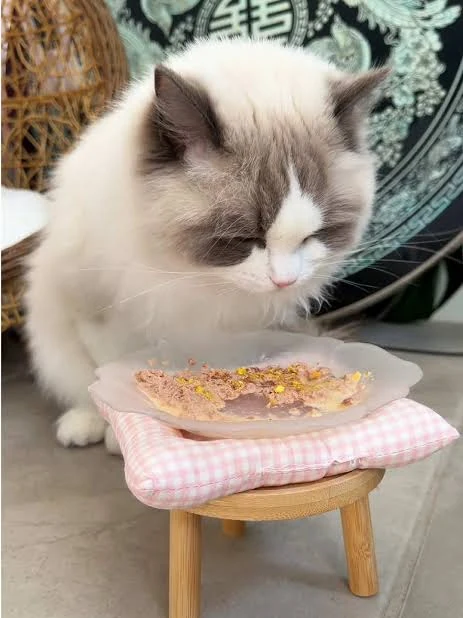
Bicolour Ragdoll eating its wet food from a raised bowl
It is at the moment of a food change that the question really arises.

A kitten leaving its cattery accumulates everything that unsettles gut flora: a change of food, a journey, a new home, new companions. That is the moment one thinks of a probiotic — and, very often, the moment one buys something other than what one believes.

Three words not to confuse, because everything else follows from them:

The CFU trap. Manufacturers declare sometimes per gram, sometimes per kilo, and the sachet does not always weigh the same. A product at 5×10¹¹ CFU/kg seems to crush one at 5×10⁸ CFU/g: they are in fact exactly the same concentration. The only question worth asking is therefore: how many bacteria are in the sachet I pour tonight? That is the figure we give in every review.

A word on method. We judge here what the labels declare and what the dose-to-price ratio is worth day to day. We do not claim to measure clinical efficacy: Enterococcus faecium SF68 is the best-studied strain in cats, which does not mean a sachet settles everything.

What a probiotic does not replace

None of these products is a medicine, and none of them deworms. Diarrhoea lasting more than two days in a kitten, blood in the stools, lethargy, refusal to eat or weight loss: that means the vet, without delay. A kitten dehydrates fast, and the most frequent causes — parasites, coccidia, giardia, infection — are treatable, but not with a powder to sprinkle. A probiotic accompanies; it does not diagnose and it does not cure.

#1
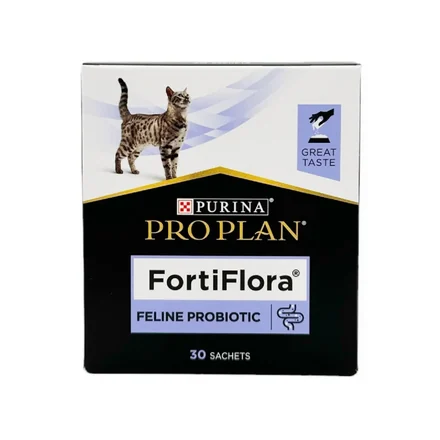
Purina Pro Plan FortiFlora, feline probiotic powder, box of 30 sachets

FortiFlora

Purina Pro Plan — probiotic

Powder — 30 sachets of 1 g

€34.99 the box online, i.e. about €1.17 per day — and €1,166 per kilo

See the sheet on purina.fr (in French)
E. faecium
SF68
Declared strain
5×10⁸CFU per dose
NonePrebiotic
≈ €1.17Per day

* Guaranteed minimum 5×10⁸ CFU/g in a 1 g sachet. Price recorded online in August 2026.

What the label says

Meat and animal by-products, mineral substances. Enterococcus faecium SF68: minimum 5×10⁸ CFU/g. Protein 55 %, fat 19 %, crude fibre 1 %. Vitamin E 7,500 mg/kg, vitamin C 1,450 mg/kg, beta-carotene 2,480 mg/kg. 3.9 kcal per gram. One sachet a day.

Our view

The benchmark, and the one most vets reach for first. The strain is the one that counts: Enterococcus faecium SF68, deposited under number NCIMB 10415, registered as zootechnical additive 4b1705. It is by far the best documented in cats, and the only case on this page where one knows precisely what one is dealing with.

With an advantage of its own: 55 % protein, which makes it the most palatable of the lot. With a cat that turns its nose up, that detail decides everything — a refused probiotic serves no purpose. Three correctly dosed antioxidants come with it: vitamin E, vitamin C and beta-carotene.

We first ranked it second, behind the Plus. The arithmetic changed our mind, and we would rather say so: the Plus does not supply more bacteria, it supplies psyllium. We set out that reasoning in the next review. At equal bacterial dose, this is therefore the cheaper of the two, and the more palatable.

What we hold against it is what we hold against others: “meat and animal by-products”, without a single species named. And a price to look in the face — €1,166 per kilo of powder. You are not buying powder by weight, you are buying microencapsulated live bacteria and a traced strain: but at over a euro per cat per day, this is not a supplement to give a whole cattery all year round.

Strengths

  • SF68 strain declared with its deposit number and additive code
  • 55 % protein: the most palatable on the page
  • Vitamins E, C and beta-carotene declared
  • Same bacterial dose as the Plus, for less money
  • 1 g format, very easy to sprinkle
  • Widely available

Reservations

  • €1,166 per kilo: the dearest by weight on the page
  • No prebiotic included
  • Animal species not named
  • €1.17 per cat per day: heavy in a cattery
#2
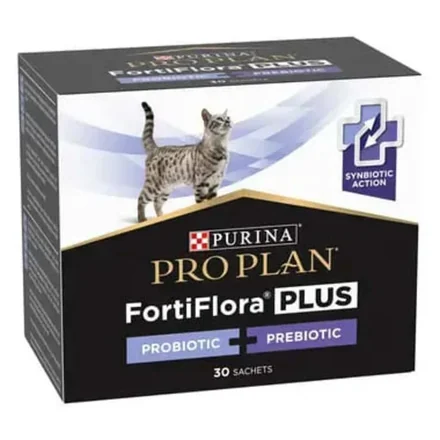
Purina Pro Plan FortiFlora Plus, probiotic and prebiotic for cats, box of 30 sachets

FortiFlora Plus

Purina Pro Plan — synbiotic

Powder — 30 sachets of 1.5 g

€36 to €39.45 the box depending on the seller, i.e. €1.20 to €1.32 per day — and €800 to €877 per kilo

See the sheet on purina.fr (in French)
E. faecium
SF68
Declared strain
≈ same as the
classic*
CFU per dose
Psyllium 33 %Prebiotic
≈ €1.20Per day

* The European label (5×10¹¹ CFU/kg × 1.5 g) would let you compute 7.5×10⁸ per sachet, one and a half times the classic. Everything indicates this is a declaration artefact and that the real dose is the same: see our view below.

What the label says

Meat and animal by-products, plant by-products (33 % dried psyllium husks), minerals. Enterococcus faecium SF68 NCIMB 10415 (4b1705): 5×10¹¹ CFU/kg, microencapsulated probiotic. Protein 37 %, fat 12.5 %, ash 7 %, fibre 1.5 %, moisture 3.8 %. Taurine 1,600 mg/kg, plus iron, iodine, copper, manganese, zinc and selenium. One sachet a day, from weaning.

Our view

We first placed this product at the top, on the strength of the CFU calculation. We were wrong, and the correction deserves to be explained in full, because it holds for a great many other labels.

The starting reasoning looked sound: 5×10¹¹ CFU/kg makes 5×10⁸ per gram, the sachet weighs 1.5 g, therefore 7.5×10⁸ per dose against 5×10⁸ for the classic. One and a half times more. Except that three things say otherwise.

First, the analytical constituents. Protein falls from 55 % to 37 %, fat from 19 % to 12.5 %. In both cases, exactly two thirds. That is not a reformulation: it is a dilution. The Plus is two thirds of classic FortiFlora and one third psyllium — 0.5 g of fibre in a 1.5 g sachet.

Then the North American labels of the same products, which declare the dose per sachet rather than per gram: 1×10⁸ CFU per sachet for the 1 g format as for the 1.5 g format. Identical.

Finally, common sense: psyllium contains no bacteria. Diluting a powder with fibre does not create any.

Conclusion: the Plus is the classic with 0.5 g of psyllium added per sachet. And that is where the price becomes interesting to look at. The box holds 15 g of psyllium in total. In bulk, that fibre sells for between €17 and €60 a kilo depending on brand and packaging: those 15 g are therefore worth between 25 and 90 cents. You pay €1 to €4.50 more than for the classic, depending on the seller.

It is no scandal at €36 — a euro for not having to dose a fibre yourself is defensible. It is rather more of one at €39.45. A curiosity in passing: the Plus is cheaper per kilo than the classic, €800 against €1,166… precisely because a third of the box is psyllium sold at the probiotic’s price.

That said, the fibre has a real interest when stools are loose, and having it pre-dosed in the sachet is convenient. If that is what you are after, talk to your vet: psyllium is also given separately, for a few cents a day, and your vet is the one who will know whether it is indicated for your cat.

Strengths

  • Same SF68 strain, declared with deposit number and additive code
  • Psyllium genuinely present and already dosed: 0.5 g per sachet
  • Taurine and six trace elements, absent from the classic
  • Microencapsulated probiotic, suitable from weaning
  • Complete, verifiable manufacturer sheet

Reservations

  • Supplies no more bacteria than the classic, contrary to what the label arithmetic suggests
  • €1 to €4.50 more for 15 g of psyllium worth less than one
  • Protein diluted to 37 %: possibly less palatable
  • The dearest box on the page
  • “Meat and animal by-products”: species not named
#3
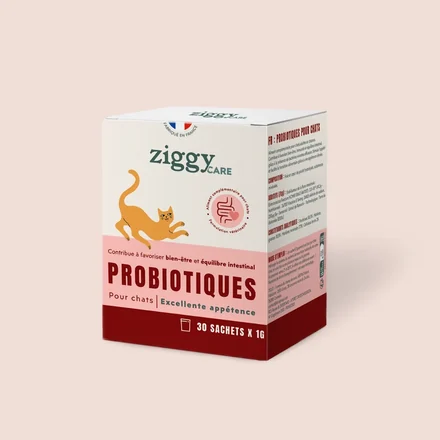
Ziggy Care Probiotics for cats, box of 30 one-gram sachets

Ziggy Care

Probiotics for cats — made in France

Powder — 30 sachets of 1 g

€34.90 the box as a one-off purchase, i.e. about €1.16 per day

Sold on the brand’s own site
E. faecium
to verify
Declared strain
Ambiguous*CFU per dose
NonePrebiotic
≈ €1.16Per day

* Ambiguous label: “3.5×10¹⁰ CFU/g” is printed under a heading reading “per kg”. Depending on which reading is right, the dose is either far above or far below the FortiFlora’s. We do not settle it.

What the label says

Hydrolysed chicken liver and heart, mineral substances. Intestinal flora stabiliser: Enterococcus faecium, deposit number and unit to be verified on the box. Vitamin E 164 mg, sodium selenite (230 µg selenium), rosemary extract, diatomaceous earth (E551c). Presented as a veterinary formulation, made in France.

Our view

On paper it is the most interesting challenger to the two Purinas: same bacterial species, same price, made in France, and a palatability base we like better — hydrolysed chicken liver and heart, named, where Purina writes “meat and by-products”. Vitamin E, selenium and rosemary as a natural antioxidant round it off neatly.

Two things stop us ranking it higher, and both are label problems, not product problems.

The unit, first. The box announces “3.5×10¹⁰ CFU/g” under a heading reading “per kg”. Both cannot be true at once: read per gram, it would be seventy times the FortiFlora; read per kilo, fourteen times less. It is the single most important figure on a probiotic, and it is unreadable.

The strain number, next. The one we noted does not match the reference deposit for the feline strain, NCIMB 10415. That may be a misreading of a tiny label — or a different strain, which changes everything.

We will update this review as soon as we can read the packaging properly. As it stands, a promising product that cannot honestly be compared with the other two.

Strengths

  • Made in France, presented as a veterinary formulation
  • Named palatability base: hydrolysed chicken liver and heart
  • Vitamin E, selenium and rosemary extract declared
  • Price in line with the classic FortiFlora

Reservations

  • Contradictory CFU unit on the label: dose impossible to establish
  • Strain number to be verified
  • No prebiotic included
  • Technical sheet less accessible than Purina’s
#4
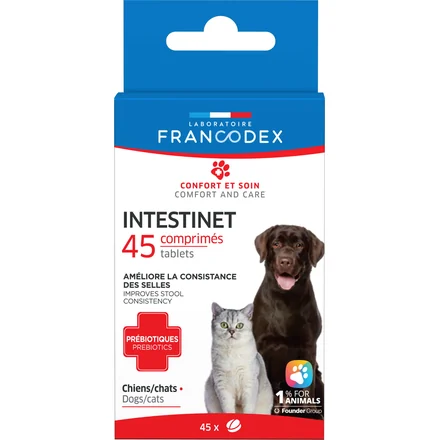
Francodex Intestinet, 45 prebiotic tablets for dogs and cats

Francodex Intestinet

Tablets — dogs and cats

Prebiotic — 45 tablets

€14.99 the box online, i.e. about €0.33 a tablet

See the sheet on francodex.com (in French)
NoneDeclared strain
CFU per dose
Inulin, pectinPrebiotic
≈ €0.33Per day

* This product is not a probiotic and does not claim to be: the word “PREBIOTICS” appears on the box. We include it because it sits on the same shelf.

What the label says

Calcium carbonate, yeasts, pumpkin powder 3 %, inulin 1.6 %, magnesium stearate, pectin 1 %, silicon dioxide. Technological additive: kaolin (E559). Sensory additive: flavouring. The manufacturer states: no more than 7 consecutive days, not before 3 months, never in case of constipation.

Our view

There is no living micro-organism in here, and that has to be said at once. The “yeasts” appear in the ingredients, with no strain and no CFU count: were they alive, the regulation would require them to be declared as a zootechnical additive with their number, as Purina does. They are therefore, in all likelihood, inactivated yeasts.

What it really is: inulin and pectin — two prebiotics —, pumpkin powder for fibre, and kaolin, an adsorbent clay. In other words a stool firmer. And that is exactly what Francodex announces, in plain words on the box: “improves stool consistency”. The brand is not cheating; it is the shelf that muddles everything.

Useful, then, but for something else. Three limits worth knowing, given by the manufacturer itself: no more than seven consecutive days, not before three months, and never in case of constipation. On a kitten in the middle of a food change, it is not the product you are looking for.

And its value for money does not hold either: at €0.33 a tablet you are paying for inulin, pectin and kaolin, when half a gram of loose psyllium costs under 3 cents and does the same job. We set that calculation out a little further down.

Strengths

  • Honestly announces what it is: a prebiotic
  • Inulin, pectin, pumpkin and kaolin: coherent for loose stools
  • Clear manufacturer sheet, with its contraindications
  • The cheapest per dose of the serious products

Reservations

  • No living bacteria: this is not a probiotic
  • Yeasts neither identified nor quantified
  • Forbidden before 3 months and beyond 7 consecutive days
  • To be avoided in case of constipation
  • One formula for dogs and cats alike
#5
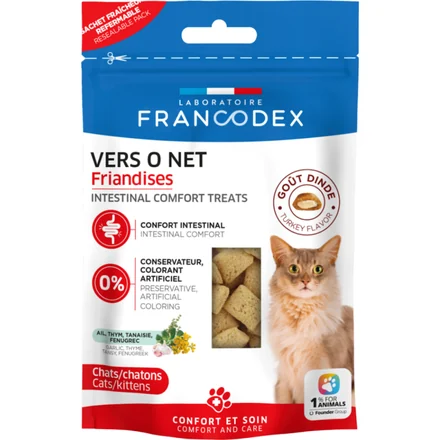
Francodex Vers O Net, intestinal comfort treats for cats and kittens, 65 g pouch

Francodex Vers O Net

Treats — intestinal comfort

Treats — 65 g pouch

€3.98 the 65 g pouch

Sold in pet shops and online
NoneDeclared strain
CFU per dose
FOS, inulinPrebiotic
€3.98 / 65 gPer pouch

* Not to be confused with the Vers O Net tablets, whose composition differs. No living micro-organism in either version.

What the label says

Meat and animal by-products (turkey 17 %, chicken 9 %), cereals, oils and fats (omega-3 1 %, omega-6 2.5 %), plant by-products (fructo-oligosaccharides 1.7 %, inulin 0.7 %, yucca 0.35 %), minerals, garlic 0.08 %, thyme 0.08 %, tansy 0.03 %, fenugreek 0.03 %. Vitamins E, C, B1, B2, B6, B12, zinc and manganese. Protein 23.5 %, fat 24 %, 4,625 kcal/kg — about 2.5 kcal a treat.

Our view

Last, and by a distance. First because it is not a probiotic: FOS and inulin are prebiotics, and there is not a living bacterium in the pouch.

Then, and this is what bothers us most, because of the name. “Vers O Net” — vers means worms in French —, traditional deworming plants on the front, an antiparasitic shelf at several retailers: everything suggests a wormer. It does not deworm. No treat replaces a veterinary wormer, and in a cattery that point is not negotiable — a worming protocol is decided with your vet, not in the treats aisle.

A word on the plants, keeping a sense of proportion. Garlic is toxic to cats: it damages red blood cells, and cats are more sensitive to it than dogs. Tansy contains thujone, which is neurotoxic. At the levels present — 0.08 % and 0.03 % — the amount actually swallowed is minute and there is no danger at the recommended dose. But putting garlic in a product meant for cats remains, to us, a questionable choice.

What is left is what it really is: a treat at 24 % fat, with vitamins and a little fibre. As a treat, why not. As an answer to a digestive problem, no.

Strengths

  • Well accepted, practical treat format
  • B-group, C and E vitamins declared
  • FOS and inulin in identified amounts
  • Modest price

Reservations

  • No living bacteria: this is not a probiotic
  • A name that suggests a wormer, which it is not
  • Contains garlic, toxic to cats — at a minute dose, but present
  • Tansy: a thujone-bearing plant, neurotoxic at high doses
  • 24 % fat: this is a rich treat
  • No official online sheet for the treats version

Reading a probiotic label in thirty seconds

Five reflexes are enough to sort out any shelf. Each opens on a click.

“Contains probiotics” means nothing. “Enterococcus faecium” does not mean much more: that is a species, not a strain. What must be read is the full identityEnterococcus faecium SF68 NCIMB 10415, additive 4b1705. The NCIMB number is the strain’s deposit number in an official collection; the 4b17xx code is its registration as a European zootechnical additive. Two strains of the same species have neither the same effects nor the same evidence behind them.

This is the calculation nobody makes, and the only one that counts. Take the two Purinas on this page: the classic announces 5×10⁸ CFU/g, the Plus announces 5×10¹¹ CFU/kg. The second looks a thousand times more concentrated — it is nothing of the sort: 5×10¹¹ divided by 1,000 grams is exactly 5×10⁸ per gram. Identical concentration.

The difference then seems to come from the weight: the Plus sachet weighs 1.5 g against 1 g. The calculation would therefore give 7.5×10⁸ CFU per dose against 5×10⁸, one and a half times more. That is what we wrote here, and it was wrong. We leave it, corrected, because the mistake is instructive.

The cross-check that saves you: the analytical constituents. Between the classic and the Plus, protein goes from 55 % to 37 % and fat from 19 % to 12.5 %. In both cases, exactly two thirds. A reformulation does not produce such round ratios; a dilution does. The Plus is two thirds classic and one third psyllium. Checking further, the North American labels of the same products, which declare per sachet rather than per gram, announce 1×10⁸ CFU per sachet in both formats. Same dose.

The moral holds in one sentence: the CFU calculation is indispensable, but it is not enough. Always cross-check it against the analytical constituents — a diluted powder shows in its protein.

A simple and unfailing trick. A living micro-organism must be declared among the zootechnical additives, with its code and its CFU count. If it appears only in the ingredient list — “yeasts”, “brewer’s yeast” — with no strain and no CFU, it is inactivated. That is not dishonest, and it keeps a nutritional interest: but it is not a probiotic.

On this page, that is exactly what separates the first three from the last two.

Nobody displays this figure, and it puts everything in perspective. Thirty one-gram sachets is thirty grams of powder. So:

  • FortiFlora — €34.99 for 30 g, i.e. €1,166 per kilo
  • Ziggy Care — €34.90 for 30 g, i.e. €1,163 per kilo
  • FortiFlora Plus — €36 to €39.45 for 45 g, i.e. €800 to €877 per kilo
  • For comparison, bulk psyllium: €17 to €60 per kilo

Should one cry scandal? No, and it must be said honestly: you are not buying powder by weight. You are buying live bacteria, microencapsulated to survive storage and then the stomach, with a traced and deposited strain. That has a real cost, and a sachet weighs only a gram.

But the figure lights up two things. First, that the Plus looks cheaper per kilo than the classic only because a third of its box is psyllium sold at the probiotic’s rate. Second, and above all, that these products are tools for a passage — weaning, moving, a change of food, the aftermath of antibiotics — and not supplements to give all year round. At over a euro per cat per day, a cattery of six cats would spend more than two thousand euros a year. That makes no sense.

Inulin, fructo-oligosaccharides, psyllium, pectin, beet pulp: these are prebiotic fibres. They feed the existing flora and give body to the stools — useful, especially when stools are loose. But a product containing only that seeds nothing.

The best of both worlds is the synbiotic: a living strain and its fibre. That is what FortiFlora Plus does with its psyllium, and that is its whole point.

Psyllium can be bought on its own, for next to nothing

Since FortiFlora Plus is nothing but classic FortiFlora with 0.5 g of psyllium added per sachet, the question deserves to be asked plainly: what if you bought the fibre separately?

Psyllium — ispaghula seed husk — sells loose at between €17 and €60 a kilo. At 0.5 g a day, the dose Purina itself uses, that comes to under 3 cents a day. Compare that with the 33 cents of an Intestinet tablet, which brings nothing beyond fibre and a clay: on the fibre front alone, the gap is tenfold.

Two uses, then, not to be confused. If you are after bacteria, take the classic FortiFlora and add nothing: it is already the best bacteria-to-price ratio on this page. If you are after the fibre effect alone — loose stools, hairballs, sluggish transit — loose psyllium does the job for a derisory sum. What makes no sense is paying for fibre at probiotic prices.

Three precautions before giving any

  • Psyllium requires the cat to drink. It is a fibre that swells on contact with water. In a kibble-fed cat that drinks little, badly dosed, it can worsen constipation instead of relieving it. One more reason to serve a share of wet food.
  • Plain psyllium, and nothing else. No flavoured, sugared or sweetened human preparation: some sweeteners have no business anywhere near a cat.
  • 0.5 g a day is the dose Purina uses in its own product. It is a reasonable starting point, not a prescription: ask your vet before giving it long-term, all the more so to a kitten.

And it obviously does not replace a probiotic: fibre feeds the flora already present, it supplies none. There is no point, therefore, in adding it to a Plus that already contains some.

What to remember

In practice, at our home: a probiotic is given during the transition, not afterwards — ideally a few days before the change of food and one to two weeks after. And it never excuses you from a gradual seven-to-ten-day transition, which remains the real preventive measure. We discuss it on our page Feeding your Ragdoll well.

A last word on budget: at between €800 and €1,166 a kilo, and over a euro per cat per day, these products are not supplements to give continuously to a whole cattery. They are tools for a difficult passage.

Sources

official product sheets Purina Pro Plan FortiFlora Plus · Purina Pro Plan FortiFlora · Francodex Intestinet (all three in French). Compositions of the Vers O Net treats and the Ziggy Care probiotics recorded from the packaging; prices recorded in August 2026 at several online sellers and liable to vary. Manufacturers change their formulas without notice: always check the box in your hand. This page describes what the labels declare; it does not replace your vet’s advice.

Explore further

More references will be added as we test them. A question about a food change, or a kitten with loose stools? Write to us.